Best Continuous Hot Water Heaters for on-Demand Comfort in Your Home
Continuous or tankless hot water heaters are designed to deliver hot water on demand, reducing energy waste and providing steady supply for busy households. This guide highlights five reliable options, focusing on electric tankless models suitable for American homes. We compare flow capacity, self-modulating technology, installation considerations, and efficiency features to help you choose a system that fits your hot-water needs and space constraints.
| Product | Brand | Key Feature | Typical Flow |
|---|---|---|---|
| Rheem 18kW 240V Tankless Electric Water Heater | Rheem Store | External digital thermostat with LED; durable copper elements | Up to 4.4 GPM |
| EcoSmart ECO 11 Electric Tankless Water Heater | EcoSmart Store | Patented self-modulating technology; compact, energy-efficient | Suitable for point-of-use |
| Tankless Water Heater Electric 110V, 3000W | Unspecified | LED display; multiple safety protections | 0.3-0.5 GPM depending on temp rise |
| Hot Water Recirculating Pump Kit | Unspecified | Programmable timer; enhanced bypass sensors | Supports existing tank system |
| ECOTOUCH 27kW 240V Tankless Water Heater | ECOTOUCH | Self-modulating; ETL certified | Up to 6.5 GPM |
Rheem 18kW Tankless Electric Water Heater

The Rheem unit delivers quick hot water with a compact design suitable for bathrooms or small utility rooms. It features an external digital thermostat with an LED display, offering about one-degree accuracy. The self-modulating control adjusts power to match demand, potentially saving energy. Copper immersion elements are designed for durability and easier field service. It supports a flow rate up to 4.4 GPM, making it a solid option for single-point use or light multi-use scenarios in smaller homes or apartments.
EcoSmart ECO 11 Electric Tankless Water Heater

The EcoSmart ECO 11 uses patented self-modulating technology to provide on-demand hot water efficiently. It continuously monitors water temperature and adjusts flow rates to maintain the set temperature within about one degree, delivering reliable comfort while saving energy. With a compact footprint (roughly 11.5 x 8 x 3.75 inches) and wall-mountable design, it’s well-suited for point-of-use installations, apartments, or remodeling projects where space is a premium. It operates with a 54 A draw and is marketed for high energy efficiency and reduced standby losses.
Compact 110V Tankless Water Heater (Under Sink)

This 110V unit provides instant hot water at the point of use. With a 3000W heater, it can raise water temperature quickly (e.g., 82°F at 0.3 GPM or 131°F at 0.5 GPM in 3–5 seconds). It features an LED display and supports both Fahrenheit and Celsius settings. Safety protections include IPX4 waterproofing, dry-burning prevention, auto power-off at over-temperature or inactivity, and leak protection. It’s a portable, lightweight option ideal for kitchens or bathrooms where traditional plumbing changes are limited.
Hot Water Recirculating Pump Kit for Tank Water Heaters
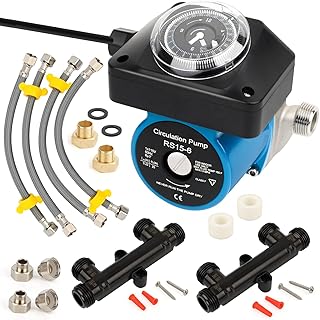
This kit enhances efficiency for homes with traditional tanks by delivering warmer water faster to distant fixtures. The programmable timer and upgraded brass bypass sensor valves support a four-line configuration and aim to reduce wait times while conserving energy. It’s designed for easy DIY installation and compatibility with common tank water heater setups.
ECOTOUCH 27kW Tankless Water Heater

ECOTOUCH’s 27kW model offers higher flow capability, suitable for 2–4 point-of-use installations. It uses self-modulating technology to adjust power based on demand, supporting up to 6.5 GPM for households with multiple hot-water needs. The unit carries ETL certification and emphasizes energy efficiency. Installation typically requires a dedicated 240V circuit and appropriate clearances, but its modular design helps with zone-based hot water delivery in larger homes or multi-bath setups.
Buying Guide: Key Purchase Considerations
- Flow rate and point-of-use needs: Determine the maximum simultaneous hot-water demand (showers, sinks, appliances) and choose a unit with a flow rate that meets that peak.
- Electrical requirements: Check available circuits and panel capacity. Higher-kW models may require new or upgraded 240V circuits and adequate amperage.
- Self-modulating technology: Look for self-modulation to optimize energy use by adjusting output to match demand, reducing waste.
- Size and installation: Consider space constraints. Tankless units are compact, but some setups require venting or specific mounting space, particularly for higher-flow models.
- Temperature control and accuracy: LED displays and precise thermostats help maintain comfortable water temperatures and reduce overshoot.
- Durability and maintenance: Copper heating elements and accessible service points minimize downtime and repair costs.
- Safety features: IP ratings, dry-fire protection, over-temp shutoff, and leakage containment add reliability and peace of mind.
- Compatibility with existing systems: If you already have a recirculation pump, confirm compatibility and required configurations for optimal performance.
- Energy efficiency: Self-modulating or high-efficiency models reduce energy use compared with traditional storage heaters, especially in households with variable hot-water demand.
- Warranty and support: Verify warranty terms and availability of replacement parts and service providers in your region.
The options listed balance compact design, reliable performance, and flexible installation. For single-dwelling homes with modest demand, smaller-capacity units with self-modulating control can provide consistent hot water without large electrical upgrades. For larger or multi-room installations, higher-flow models with robust 240V circuits and proper regulatory compliance offer better performance and user satisfaction. Always consult a licensed electrician or plumber to assess your home’s electrical infrastructure and local code requirements before purchasing and installing a tankless system.